This is a slightly different article. It is not about a technique, but about a question that now runs through all of aesthetic medicine: our relationship — increasingly mediated by screens — with our own image.
When the screen distorts reality
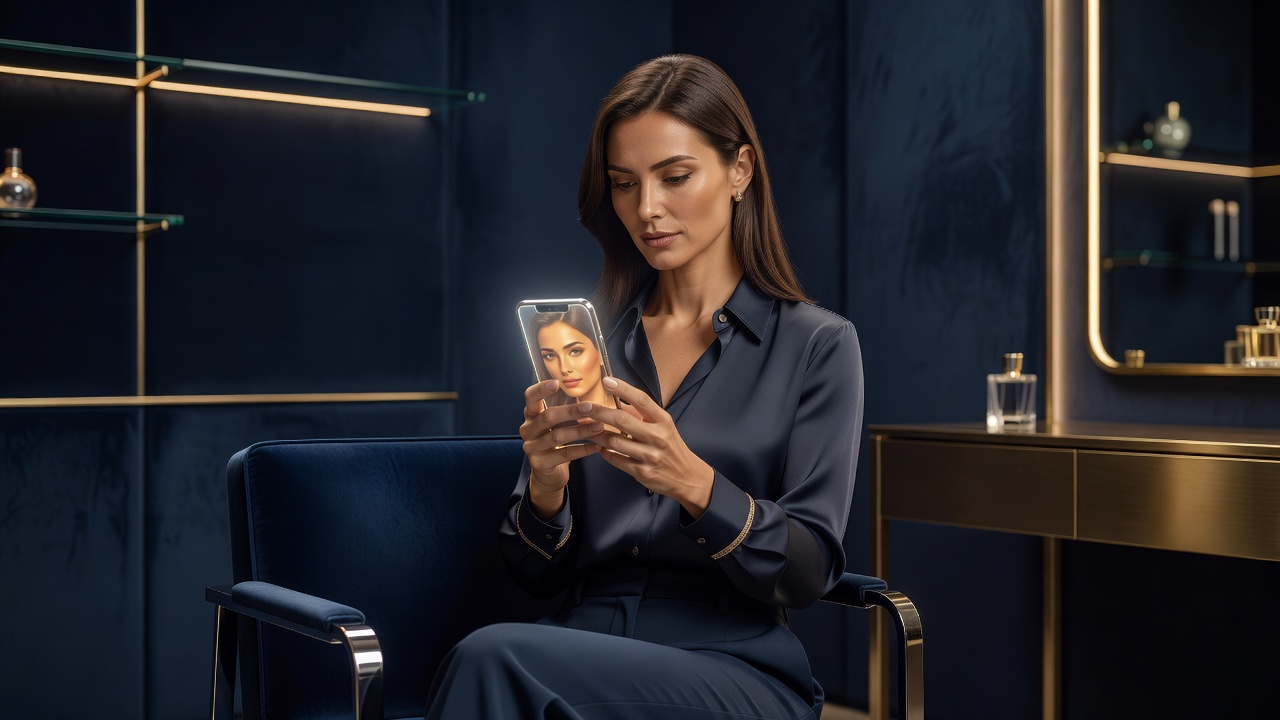
A phenomenon has emerged in the medical literature: 'Snapchat dysmorphia' (described as early as 2018 in JAMA Facial Plastic Surgery). Patients no longer ask to look like a celebrity, but like the filtered version of themselves — fuller lips, a refined nose, bigger eyes. The problem: that face does not exist. It is an image, not a person. Research has shown that heavy use of editing apps is associated with lower self-esteem and greater acceptance of cosmetic surgery.
AI, a new amplifier
Generative artificial intelligence adds another layer. Cases have been reported in the media, including within the tech world itself, of people developing delusional beliefs fed by prolonged exchanges with chatbots — a phenomenon that recent reviews propose to call 'AI psychosis' (JMIR Mental Health, BJPsych Open, The Lancet Digital Health, 2025-2026). A commentary in Internet Interventions usefully reminds us that this is not new: media have always been able to feed delusions; AI, through its conversational, 'tailor-made' nature, simply amplifies the mechanism.
The link with my work? A tool that constantly reflects an idealised, editable image of oneself can establish or worsen a distortion of body perception. And that is precisely the ground of body dysmorphia.
Body dysmorphia: a real disorder
Body dysmorphic disorder (BDD) is a recognised psychiatric condition: an excessive, intrusive preoccupation with a physical flaw that is imperceptible or minor to others. It affects around 1 to 2% of the general population — but far more among people seeking aesthetic care: studies report on the order of 15 to 20%, and sometimes more for certain requests (rhinoplasty in particular).
The key point: in these patients, surgery does not make the distress disappear. Most often, it shifts it to another part of the body, or worsens it. This is why body dysmorphia is generally considered a contraindication to cosmetic surgery: operating would mean treating the apparent symptom while ignoring the real cause.
My role: knowing how to say no
A significant part of my work is to listen to and assess the request, not just the face or body. When I perceive the signs of body dysmorphia — repeated, never-satisfied requests, unrealistic expectations, disproportionate distress, obsession with an invisible detail — my duty is not to operate, but to refer to appropriate care (psychologist, psychiatrist). Declining a procedure is sometimes the greatest service a surgeon can offer.
This is also the whole point of my practice: aiming for a natural result that reconciles you with your real image, rather than chasing a filtered version that does not exist. It is the thread of my article on invisible cosmetic surgery.
My goal is not to turn you into someone else, nor into your own filter: it is to help you feel good with the face that is yours.
Sources: Rajanala S. et al., 'Selfies—Living in the Era of Filtered Photographs', JAMA Facial Plastic Surgery, 2018; 'Cosmetic Surgery and Body Dysmorphic Disorder – An Update', PMC — PMC5986110; 'AI Psychosis', JMIR Mental Health 2025 — PMID 41273266; 'AI psychosis: mechanisms, clinical risks', BJPsych Open 2026 — PMID 42273786; 'Functional typology of LLM-associated psychotic phenomena', The Lancet Digital Health 2026 — PMID 41833467; 'AI psychosis is not a new threat', Internet Interventions 2025 — PMID 41141286.